
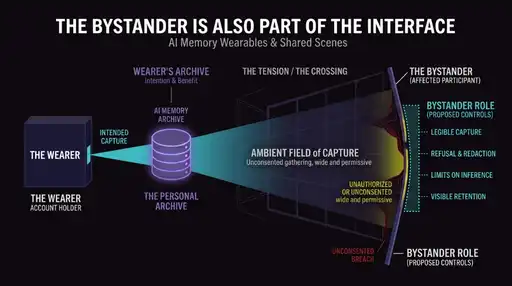
The Bystander Is Also Part of the Interface
October 22, 2026 by Gerardo I. Ornelas
Editorial Series: Human–AI Interaction & Research Field Notes
Target Question: How should AI memory wearables handle people who never chose to use them?
Direct Answer: AI memory wearables should treat nearby people as affected participants. Capture should be legible, refusal or redaction practical where possible, and inference and retention limited. A “personal” archive should not erase the agency of people whose lives helped create it.
A device can belong to one person while its memory contains everyone around them.
That is the tension inside AI lifelogging wearables. They promise to recover details and search the recent past. But conversations, meetings and family moments are shared before software turns them into one person’s archive.
The product may have one account holder. The interaction has more than one participant.
Personal Memory Is Built from Shared Scenes
Memory wearables can move part of the decision to record into the system.
Looki describes its L1 as using visual and audio context to create recaps, summaries and searchable memories. Its documentation says capture varies by mode, content begins on the device, and a “Trust Light” and sounds indicate capture. Those are vendor claims, not independent findings.
AI may select a moment, interpret and connect it, then retrieve it later. Someone in the scene can become material in a narrative they never see.
What the Research Found—and Did Not Find
A 2026 UbiComp Companion paper, “Black Mirror?: Public Sensemaking of AI-Powered Lifelogging Wearables,” analyzed 5,053 Chinese- and English-language social-media comments using Looki L1 as an empirical lens.
Across both contexts, commenters discussed utility alongside surveillance, privacy resignation and bystander concerns. English-language discussion emphasized hacking, interpersonal evidence and power more often; Chinese-language discussion more often emphasized labor control, governance surveillance and inevitability.
The study maps public interpretation. It does not test long-term use, measure privacy outcomes or establish universal attitudes. Its narrower value is showing that people recognize AI-mediated memory changes more than recording: it changes who can interpret a shared moment later.
Source: arXiv:2609.34950
The Wearer Is Not the Only Stakeholder
Ambient systems make the usual account-based definition of “user” unreliable.
The wearer chooses the product and receives the benefit. A bystander may supply face, voice, location, behavior or relationship context without choosing the system. The archive is personal in access but social in production.
That suggests a design principle: the shared scene—not the account—is the relevant unit of interaction.
This mirrors the challenge we explored in what must stay fixed when software generates its own interface: when the boundary of an interface becomes fluid, systems still need stable invariants that protect participants from unpredictable or ambient capture.
What a Bystander Role Could Include
A bystander role need not prompt every passerby. It recognizes that people outside the account have legitimate interests.
Legible capture
Active sensing should be visible or audible, difficult to disable and understandable without knowing the brand.
Refusal and redaction
In private or recurring settings, people should be able to pause capture, exclude themselves or request removal—including from derived memories where feasible.
Limits on inference
Consent to appear in a clip is not automatically consent to emotion analysis, relationship labeling, behavioral conclusions or permanent searchability.
Visible retention
The product should explain what stays local, reaches the cloud, persists after generation and disappears on deletion—including to bystanders when disputes arise.
These are design proposals, not findings validated by the study. Just as autonomous systems need controls that push back to prevent authority from drifting silently, ambient sensors require explicit boundaries that protect those outside the primary feedback loop.
The Counterargument: Friction Can Erase the Benefit
Low-friction capture may support memory difficulties, caregiving, safety or demanding work. Perfect consent is impossible in public, and aggressive prompts could stigmatize assistive use.
The answer is not one universal permission ritual. Controls can vary by context: stronger expectations in homes and meetings, clear signaling in public, local processing by default, minimal retention and accessible redaction after capture.
The goal is not friction everywhere. It is avoiding invisible costs for everyone except the buyer.
Good Interaction Serves People Outside the Account
Ambient AI operates inside rooms, relationships and institutions. The person receiving the service may not be the only person affected.
A memory wearable can satisfy the wearer and still create a poor interaction for everyone nearby.
Much like how the interface ended, but the interaction didn’t, ambient systems create ripple effects well beyond the primary user’s screen.
If AI turns a shared moment into one person’s searchable memory, the question is not only, “Did the user consent?” It is also: who else became part of the interface without being asked?
Primary Sources
- UbiComp Companion 2026: Black Mirror?: Public Sensemaking of AI-Powered Lifelogging Wearables
- Looki: Looki L1 AI Wearable
- Looki: Looki L1 AI Wearable Camera & Data Privacy
- Related Analysis: When Software Generates Its Own Interface, What Must Stay Fixed?
- Related Analysis: Why Autonomous Systems Need Controls That Push Back
- Related Analysis: The Interface Ended. The Interaction Didn’t.
Frequently Asked Questions
Are AI memory wearables always recording?
No. Capture varies by product and mode. Looki describes mode-dependent capture and indicators; these claims need independent evaluation.
© Gerardo I. Ornelas
Systems architect, founder, and advisor for governed AI and trusted visibility.