
The Interface Ended. The Interaction Didn’t.
October 09, 2026 by Gerardo I. Ornelas
Editorial Series: Human–AI Interaction & The Trust Stack
Target Question: Can practicing with AI make people more willing to participate without it?
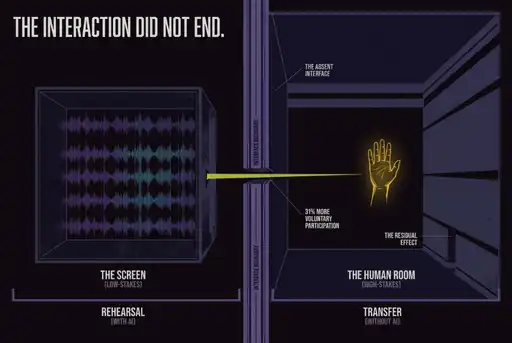
Direct Answer: AI can affect behavior after a session ends by providing a low-stakes place to rehearse. In a preregistered field experiment with 759 MBA students, two sessions with a voice-based AI discussion partner were followed by about 31% more voluntary contributions in later classes. That does not prove durable learning, but it changes the HCI question: the value of an interface may be what a person can do when it is absent.
We usually evaluate an AI tool while someone is using it.
Was the answer accurate? Did the task take less time? Was the person satisfied? Those are sensible questions, but they assume the interaction begins when the interface opens and ends when it closes.
For learning systems, that may be the wrong boundary.
The more important output may appear later: in the meeting where someone finally speaks, the classroom where a question is asked, or the moment a person attempts the work without assistance.
The interface ended. The interaction did not.
What Happened After the AI Disappeared
A new preregistered field experiment followed 759 MBA students across ten course sections. Each student was randomly assigned two of ten class sessions to prepare for with a purpose-built voice-based AI discussion partner.
After two uses, students made about 31% more voluntary contributions in each later class session. Students who used the tool more also reported greater comfort speaking up and greater perceived learning, though not greater focus or motivation.
The AI did not speak in class. It did not raise a hand. It was not present when participation was measured.
Its possible effect showed up in the person.
That is a more interesting HCI story than “AI improves education.” The study is a new preprint, and it measures participation rather than durable knowledge. Its deeper value is the possibility it makes visible: interaction can transfer beyond the interface.
The Product May Be Rehearsal, Not the Answer
Most AI products are designed around production. Generate the paragraph. Solve the problem. Recommend the decision. Complete the task.
Rehearsal has a different goal. It gives a person somewhere to try, hear themselves, revise, and return to the human setting better prepared.
That distinction matters because production can replace a human performance while rehearsal can strengthen it.
The same model may do either. The relationship depends on how the interaction is designed.
An answer engine asks, “What can the system do for you now?” A rehearsal system asks, “What will you be able to do after you leave?”
This tension echoes throughout our research on where AI should end in creative work—when tools optimize purely for output generation, they risk bypassing the human development loop entirely.
HCI Needs an Afterlife Metric
In enterprise software and design systems, we often draw a boundary around a task and optimize what happens inside it. Autonomous and adaptive systems are making that boundary less reliable.
If a tool changes later human behavior, evaluation needs to follow the effect.
Transfer
Does a capability practiced with the system appear in the real setting without it?
Dependence
Does repeated use expand what the person can do alone, or make the person less willing to act without assistance?
Distribution
Who benefits? A tool that helps already-confident participants speak more may increase activity while leaving the quietest people untouched.
Quality
More participation is not automatically better participation. Did contributions become more thoughtful, more diverse, or more useful to the group?
Fade
Can the interface become less necessary over time? A learning tool should be able to succeed by making itself smaller.
These questions move evaluation from immediate output to human trajectory. Just as autonomous systems need controls that push back to keep operators grounded in reality, learning interfaces must measure what capability remains when the machine steps aside.
The Pressure Test: Speaking More Is Not the Same as Learning More
The field experiment does not establish that students learned more over the long term. It reports greater voluntary contribution and perceived learning; focus and motivation did not increase.
Participation is also culturally and personally complicated. Silence can reflect exclusion, but it can also reflect reflection, listening, anxiety, language, status, or a deliberate choice not to perform confidence.
A system should not standardize one visible behavior as the universal sign of learning.
The stronger claim is narrower: a low-stakes AI conversation may help some people carry readiness into a later human room. That possibility deserves evaluation without being inflated into a verdict on education.
The Interface Should Leave Something with the Person
Good human–AI interaction is often described as efficient, accurate, or personalized.
For learning, I would add another quality: residual value.
After the session ends, what remains with the person?
- A clearer thought.
- A practiced sentence.
- A question they are ready to ask.
- A skill they can perform without the tool.
- Enough confidence to enter the human conversation.
If nothing transfers, the system may still be useful. But it is assistance, not development.
The best AI tutor may not be the one that produces the strongest answer. It may be the one whose effect survives its absence.
And that leaves a harder question: if an interface changes what a person does after leaving it, where does the interaction actually end?
Primary Sources
- Dan J. Wang et al. (Oct. 7, 2026): How assigned AI use before class shapes active student engagement in class
- Related Analysis: Where Should AI End in Creative Work? The Boundary Should Stay Revisable
- Related Analysis: Why Autonomous Systems Need Controls That Push Back
- Series Archive: Human–AI Interaction & Research Field Notes
Frequently Asked Questions
Does practicing with AI improve learning?
This study found greater later class participation and perceived learning, not proof of durable learning. The distinction should remain explicit.
Should AI replace human discussion practice?
No. The strongest use case is rehearsal that prepares a person for human participation, not substitution for the human setting.
© Gerardo I. Ornelas
Systems architect, founder, and advisor for governed AI and trusted visibility.