
Why Autonomous Systems Need Controls That Push Back
September 28, 2026 by Gerardo I. Ornelas
Editorial Series: Human–AI Interaction & The Trust Stack
Target Question: What controls should autonomous and automated systems give people?
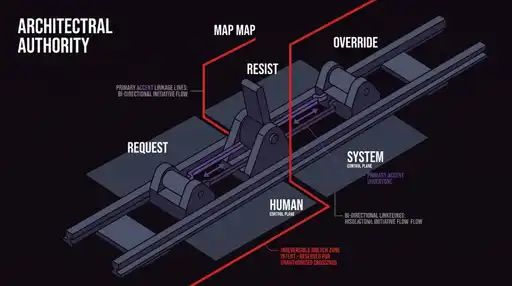
Direct Answer: Autonomous systems should give people controls that reveal current state, preview consequences, resist unsafe or unavailable actions, and provide a reliable override. A control should not merely send a command; it should show how human intent and machine activity relate. As software acts independently, intervention must become easier to find and harder to misunderstand.
Automation has a strange habit: the more capable it becomes, the less visible its controls become.
The thermostat learns. The car decides. The building adjusts. The agent continues working after we stop typing. Intelligence moves into the background, while the person infers what the system is doing from a light, notification or eventual consequence.
A new HCI paper offers a concrete provocation: bring buttons back.
The researchers propose Physically Stateful Interfaces—buttons, switches and knobs that change physical state as automation acts. A button might reset itself, resist or hide when an action is unavailable, or assert itself when the system needs human attention.
This is not nostalgia. It is a design argument about agency.
A Control Should Communicate in Both Directions
Most controls describe what a person can ask the system to do. They are weaker at describing what the system is already doing.
That mattered less when software waited for input. It becomes critical when the computer can initiate, continue and coordinate actions on its own.
The paper identifies three behavior families:
- Self/Reset: a control returns or moves as the system changes state.
- Resist/Hide: it makes an unavailable or unsafe action harder or impossible.
- Assert/Unhide: it surfaces when intervention becomes relevant.
Together, they turn a control from a static request mechanism into a mediator between person and automation. The person acts on the interface. The system also acts through it.
Why a Screen Is Often Not Enough
A screen can display almost anything. That flexibility is useful, but it can separate action from state.
You turn a virtual control and look elsewhere for confirmation. You approve an agent plan, then inspect a log to learn what happened. You receive an alert after the system crossed the boundary.
Physical state can couple intention and consequence:
- A switch that moves when automation takes over makes control transfer visible.
- A dial that resists beyond a safe limit provides feedforward.
- A button that reappears when judgment is required makes escalation tangible.
The principle travels beyond hardware.
A digital interface can also push back. It can disable an action with an intelligible reason, surface an override when needed, distinguish preview from execution, and show whether the human or system currently holds control.
The point is not the material. It is the coupling.
Three Promises Every Autonomous Control Should Keep
1. Show who is acting
People should be able to tell whether a state came from their command, a standing policy or an autonomous process. Control transfer cannot remain implicit.
2. Make the next consequence legible
Before action, the interface should show what the system can affect—especially when one gesture triggers many downstream steps.
3. Keep intervention dependable
A stop or override must operate outside the same uncertain reasoning process it constrains. It should terminate or contain downstream execution, not merely ask a model to reconsider.
These promises turn “human control” from a value statement into an interaction contract.
Original Synthesis: A Control Surface Is a Negotiation Surface
For most of computing history, controls translated human intention into machine action.
In autonomous systems, they must continuously negotiate initiative.
- Who is acting now?
- Which options remain available?
- When is the system requesting judgment?
- What happens if the person takes control back?
A useful control surface does not pretend the human is always operating the system. It makes the changing relationship visible.
The computer no longer waits, so the interface cannot remain passive.
What This Means for AI Agents
Chat windows are poor at persistent state. “I’ll handle it” can conceal tools, permissions, duration and side effects.
An agent interface needs equivalents of the stateful button:
- A plan that updates during execution;
- Constraints that visibly narrow actions;
- Approval attached to the consequence it authorizes;
- An interrupt that confirms which processes stopped;
- An explicit handoff; and
- A recovery path outside agent improvisation.
The interface should not only accept intent. It should give intent somewhere durable to live.
This is where execution-time intervention connects directly to the Authority Layer and protocols like Agent Permission Protocol (APP)—moving past ambient authority so that runtime reasoning cannot silently expand execution authority. As we explored in what must stay fixed in generated interfaces, when the interface adapts dynamically, its invariants around authority and state must stay rock solid.
Accessibility and the Danger of Literalism
Physical controls are not automatically accessible. Resistance can exclude users with limited strength. A hidden control may be undiscoverable. Visual state needs tactile, auditory and semantic equivalents.
The lesson is not “hardware good, screens bad.” Every modality must expose the same essential state and consequence. Good systems use redundant signals and multiple forms of intervention without contradictory controls.
Limits and Counterarguments
The Physically Stateful Interfaces paper is a design concept, not proof that one vocabulary will work everywhere. Actuated hardware adds cost, maintenance and failure modes. Screens may be more adaptable.
But the provocation holds: when automation becomes ambient, the interface must become more explicit about state and intervention, not less.
Good automation can work in the background. Its authority, state and brake should not.
Primary Sources & Further Reading
- Goedicke et al. (Sep. 13, 2026): Physically Stateful Interfaces: Expanding Dynamic Affordances with Actuated Controls
- Related Analysis: When Software Generates Its Own Interface, What Must Stay Fixed?
- Related Analysis: Verifiably Human — Part II: The Death of Ambient Authority
- Related Analysis: Securing Autonomy: LangGraph, APP, and Execution-Time Authority
- Related Analysis: Labor Day in the Age of AI: The Future of Work Is a Human Agency Problem
- Related Analysis: Where Should AI End in Creative Work? The Boundary Should Stay Revisable
Frequently Asked Questions
What is a physically stateful interface?
A control whose state changes to communicate or constrain automation.
Why do autonomous systems need overrides?
They can continue acting after the initiating command.
Can digital controls use the idea?
Yes: preserve legible state, feedforward and dependable intervention.
© Gerardo I. Ornelas
Systems architect, founder, and advisor for governed AI and trusted visibility.