
Securing Autonomy: Applying the Agent Permission Protocol (APP) to LangGraph Patterns
February 06, 2026 by Gerardo I. Ornelas
As a Founder at Crittora and Co-Author of the Agent Permission Protocol (APP), I keep coming back to one core truth: in autonomous systems, authority is the real boundary.
LangGraph is excellent for composing multi-agent workflows, but most implementations still lean on ambient authority. If a tool is mounted in runtime, the agent can often reach it just because it exists. That is convenient for prototyping and dangerous in production.
My view is simple: model reasoning can propose actions, but only explicit authority should permit actions. Without that execution-time authority layer, even well-designed agent graphs are still unsafe.
Diagram 1: Authority Flow for Safe Agent Execution
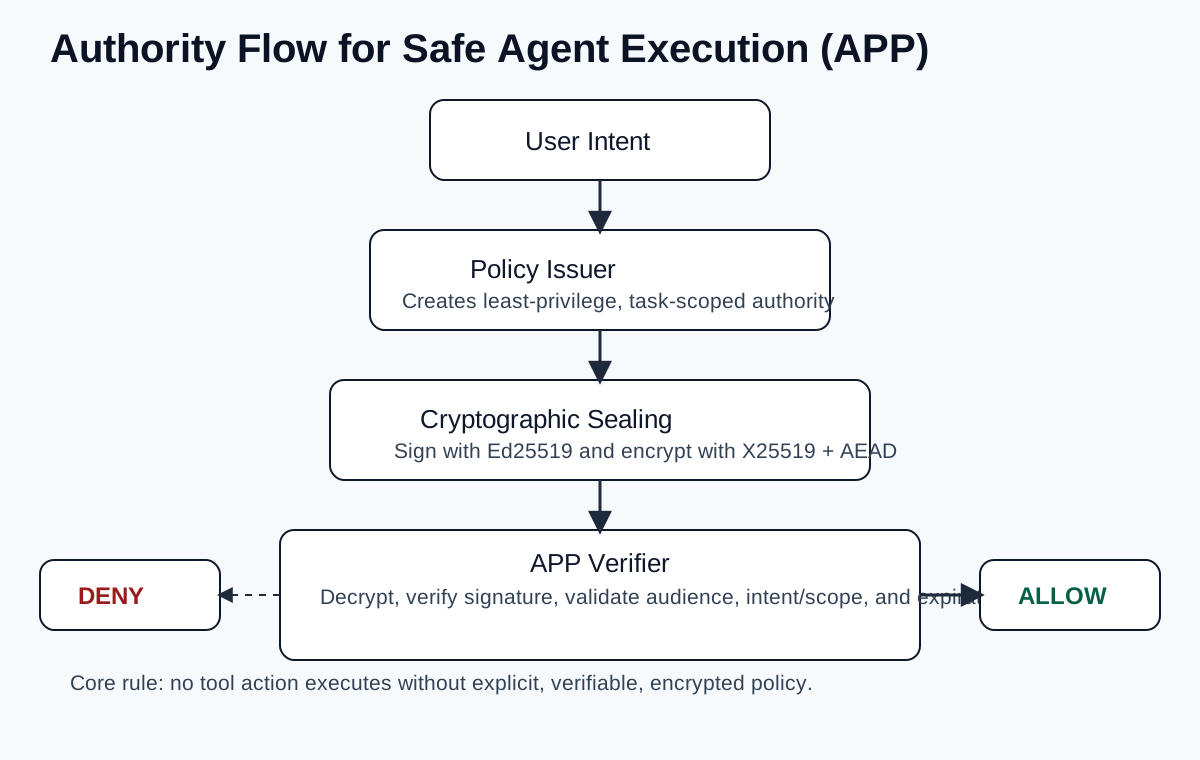
What this shows: Agent actions should be authorized by cryptographically verifiable policy, not by model output alone.
1. Prompt Chaining: Verifying Intent at Every Link
The Pattern: Breaking a complex task into a sequence of LLM calls, where the output of one node is the input for the next.
- My APP Lens: In a standard chain, authority is usually inherited implicitly through tool availability. APP requires each link to carry its own sealed permission policy at execution time.
- What I See: Static chains tend to inherit broad permissions from the initial trigger, even when later steps only need narrow scope.
- Risk: Privilege Creep. As systems evolve, agents inherit increasingly broad authority over time as tools accumulate.
- My Recommendation: Use Time-Bounded Authority. Give every node a unique, short-lived policy that expires by default.
2. Routing: The "Confused Deputy" Trap
The Pattern: A router node uses an LLM to decide which downstream worker or tool to invoke based on user intent.
- My APP Lens: Routing is intelligence, not authority. A model can suggest where to go next, but enforcement must happen outside the model.
- What I See: Routers frequently become a Confused Deputy when one agent serves multiple users without explicit, verifiable grants.
- Risk: Ambient Authority Leakage. A router may be manipulated to invoke a sensitive tool that is mounted in the runtime but unrelated to the current intent.
- My Recommendation: Implement Audience Binding. The APP verifier MUST bind policy to the exact agent (audience) that is authorized to act.
3. Parallelization: Atomic Enforcement at Scale
The Pattern: Forking a workflow to execute multiple tool calls or agent tasks simultaneously.
- My APP Lens: Every parallel branch is its own execution event and needs its own cryptographic proof of authorization.
- What I See: Parallel workers often share credentials, which blurs what each branch is actually allowed to do.
- Risk: Unverifiable Audit Trails. Without explicit authority policies, enforcement decisions cannot be precisely governed or audited.
- My Recommendation: Deterministic Verification. Every branch MUST pass the verifier pipeline (decrypt, verify signature, check expiration) before any action is executed.
Diagram 2: LangGraph Pattern vs LangGraph + APP
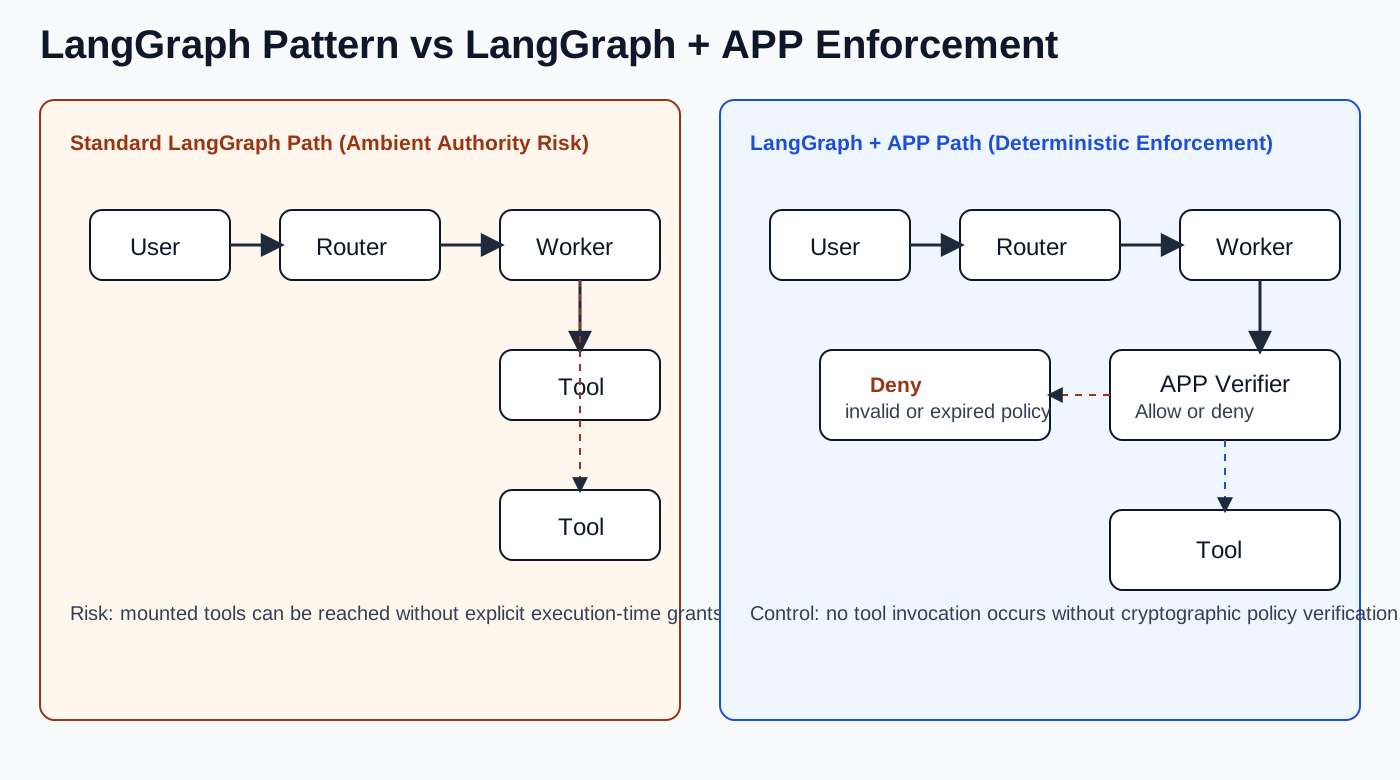
What this shows: LangGraph handles orchestration; APP handles authorization and enforcement.
APP Compliance Checklist for LangGraph Developers
To move from "experimental" to "production-ready," your LangGraph agents should meet these mandatory APP requirements:
| Requirement | Description |
|---|---|
| Fail-Closed | Any failure in cryptographic or policy validation results in immediate denial. |
| No Ambient Authority | No action occurs without a valid, explicit, verifiable, and encrypted permission policy. |
| Cryptographic Sealing | Policies MUST be signed (Ed25519) and then encrypted (X25519 + AEAD). |
| Explicit Intent | Every policy MUST bind the specific intent and scope to the execution. |
Diagram 3: Risk-to-Control Matrix (APP)
| Agentic Security Risk | APP Control | Why It Works |
|---|---|---|
| Privilege Creep | Time-bounded, task-scoped policy | Authority expires by default and does not silently accumulate |
| Confused Deputy | Audience binding + explicit grant | The acting agent must match the authorized audience |
| Ambient Authority Leakage | No action without policy verification | Mounted tools are not callable without explicit permission |
| Unverifiable Audit Trails | Deterministic verifier pipeline | Every allow/deny decision is reproducible and auditable |
What this shows: Each common autonomy risk maps to a concrete APP control, enabling measurable governance.
Quick Answers (AEO)
- What is APP in one line? APP is a cryptographic authorization layer for autonomous agent actions.
- Can LangGraph alone secure autonomy? No. LangGraph orchestrates reasoning and flow, but APP enforces execution-time authority.
- What is the core rule? No tool action without an explicit, verifiable, encrypted policy.
Conclusion: Intelligence is Not Authority
From my perspective, LangGraph gives us orchestration power, but APP supplies the authority controls required for safe autonomy. When reasoning and authority are separated, risk becomes measurable, enforcement becomes auditable, and autonomous execution becomes governable.
Related Reading
© Gerardo I. Ornelas
Systems architect, founder, and advisor for governed AI and trusted visibility.