
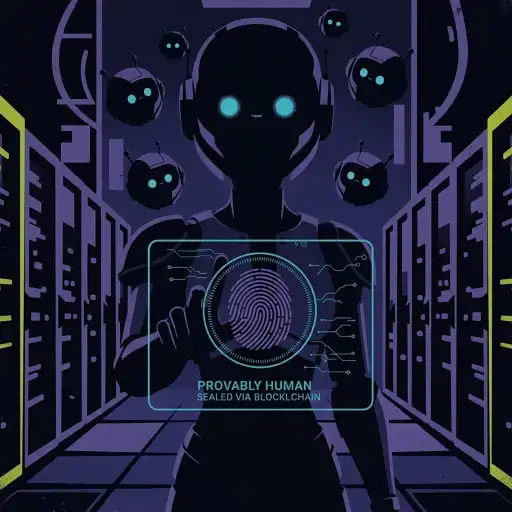
Verifiably Human — Part I: Everything Is Synthetic by Default
February 07, 2026 by Gerardo I. Ornelas
I started thinking about this after watching a video that felt completely real.
No glitches. No weird eyes. No obvious artifacts.
Just a person talking.
It took me a few minutes to realize it wasn’t.
That moment stuck with me, not because it was impressive, but because it was boring. This wasn’t some futuristic deepfake demo. It was just content. The kind you scroll past every day.
And that’s when it clicked:
We’re already past the point where “spot the AI” works.
Most conversations about synthetic media still revolve around detection. Better classifiers. Better watermarking. Better ways to catch fakes.
But detection is a losing game.
It assumes there’s always something to notice.
There won’t be.
The models will get better. The artifacts will disappear. The tells will vanish. And even if detection improves, it becomes an arms race with no finish line.
So I think we’re solving the wrong problem.
The real shift isn’t from human to AI.
It’s from implicit trust to explicit provenance.
Identity Isn’t Enough Anymore
The internet was built on identity.
You log in. You authenticate. You get a session. From that point forward, the system assumes you’re present, intentional, and acting with agency.
That model worked when software was passive.
It breaks when software starts acting.
We already see this in production systems: credentials that live forever, automations nobody remembers approving, agents quietly holding permissions long after the human has stepped away.
Once something is authenticated, it inherits ambient authority.
And everything downstream quietly trusts it.
That same assumption exists with content.
If a known account posts something, we treat it as real.
If a verified user uploads a photo, we assume it came from them.
If a familiar voice speaks in a video, we believe it.
But identity doesn’t tell you how something was created.
It doesn’t tell you whether a human was present at the moment of creation.
It doesn’t tell you whether an agent touched it.
It doesn’t tell you what tools were involved.
Identity answers who.
It doesn’t answer origin.
And origin is what matters now.
Detection Is Backward
Right now, we treat content as human by default.
Then we try to detect when it isn’t.
That’s backward.
It made sense when AI-generated media was rare. It doesn’t make sense when synthesis becomes the baseline.
We’re heading toward a world where most content will be machine-assisted, machine-generated, or machine-altered in some way. That’s not dystopian. It’s just practical. Tools are getting better. People will use them.
So instead of asking:
“Is this AI?”
We should be asking:
“Is this provably human?”
That’s a subtle shift, but it changes everything.
Because now humanity isn’t an assumption.
It becomes a property.
A capability.
Something that has to be explicitly proven.
In other words: everything becomes synthetic by default.
Human-made becomes the exception.
This Isn’t About Purity
Let me be clear: this isn’t some nostalgic argument for a pre-AI internet.
I don’t care if people use AI to clean up photos, fix lighting, summarize drafts, or enhance audio.
That’s not the point.
The point is transparency.
If content involved automation, that should be visible.
If it was captured directly by a human, that should be provable.
If it passed through tools, we should be able to see which ones.
Right now, all of that collapses into a single opaque blob called “a post.”
We’ve lost the chain of custody.
And once you lose provenance, everything becomes vibes.
Software Crossed a Line. Content Is Next.
We didn’t enter the agent era because models got smarter.
We entered it because software started acting.
Once agents could move money, provision infrastructure, message customers, and update records, the risk surface shifted from:
“What did it say?”
to:
“What did it do?”
Content is going through the same transition.
Creation is becoming executable.
Pipelines are automated. Generation is instantaneous. Distribution is algorithmic.
Human intent is no longer guaranteed to be in the loop.
And yet our trust model hasn’t changed.
We still behave as if a person is always on the other end.
They aren’t.
Sometimes it’s a model. Sometimes it’s a workflow. Sometimes it’s an agent running on credentials nobody has looked at in months.
So we need a new primitive.
Not better detection.
Not smarter classifiers.
A way for content itself to carry proof of origin.
The Shift
The idea I keep coming back to is simple:
Humanity has to become explicit.
Not inferred.
Not guessed.
Not assumed.
Explicit.
Content should be treated as synthetic unless it carries verifiable proof that a human was present at creation.
Not “probably human.”
Provably.
That means:
- Proof at the moment of capture
- Cryptographic sealing
- Clear lineage through edits and transformations
- Visible indicators when AI tools intervene
It sounds heavy.
But it’s the same evolution we already went through with software.
We learned (the hard way) that identity isn’t enough.
You need scoped permissions. Explicit approval. Auditable execution.
Now we’re facing the same reckoning with content.
Where This Is Going
This series is my attempt to think through what a Verifiably Human internet could look like.
Not as policy. Not as vibes. As infrastructure.
In the next parts, I’ll walk through:
- why identity-based trust collapses in an agentic world
- how “human provenance” could actually work mechanically
- where blockchain fits (and where it doesn’t)
- and the failure modes we’ll hit if we get this wrong
But for now, this is the core realization:
We don’t have an AI problem.
We have a provenance problem.
And until humanity itself becomes something we can explicitly verify, authenticity will always lag synthesis.
Related Reading
© Gerardo I. Ornelas
Systems architect, founder, and advisor for governed AI and trusted visibility.