
Ownership Without Exit Is Just Tenancy
October 10, 2026 by Gerardo I. Ornelas
Editorial Series: Research & Field Notes / Authority & Trust
Target Question: Do you really own a digital asset if you cannot use it outside a platform?
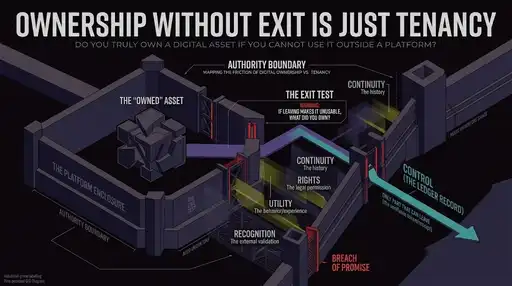
Direct Answer: Not fully. A ledger may prove control of a digital token, but meaningful ownership also depends on whether the object, its history, and its rights remain usable after you leave. Blockchain can make control and provenance portable; it cannot force every system to preserve utility or honor the claim. Ownership without a credible exit is closer to tenancy.
Ownership Without Exit Is Just Tenancy
If leaving a platform makes a digital object unusable, invisible, or meaningless, what did you own?
The question becomes real when a marketplace closes, a game changes its rules, or a creator loses an account. Then “ownership” breaks into smaller promises—and people discover which ones they actually received.
A receipt may survive. The experience may not.
Ownership without exit is tenancy.
One Word, Five Promises
Digital products often present ownership as binary: yours or not yours. The human experience is layered.
- Control: Can you hold, transfer, sell, delegate, or revoke access without asking the platform?
- Continuity: Does the object and enough history to understand it survive the service?
- Recognition: Will another system accept the claim as legitimate?
- Rights: May you display, modify, resell, license, lend, or use it commercially?
- Utility: Does it still do anything meaningful outside its original environment?
A system may provide one layer and imply the rest. That is where “ownership” becomes misleading.
What a Token Standard Can Prove
ERC-721, the widely used non-fungible token standard on Ethereum, defines basic functionality for tracking and transferring distinct tokens. It identifies owners and standardizes transfers and approvals.
That matters. Control no longer has to depend on one marketplace’s database.
But the standard also reveals the boundary. Its metadata extension is optional. A token URI may point to external information and may be mutable. The standard leaves questions about which contracts are canonical outside its scope.
A ledger can make a control claim legible. It does not guarantee that another platform will render the asset, preserve its media, honor its license, reproduce its behavior, or recognize its cultural meaning.
That is not a failure of ERC-721. It is a category distinction.
A deed is not the house. A token is not the entire experience it points toward.
The Exit Test
What survives if the platform disappears—or if I choose to leave?
The answer need not be “everything.” A sword designed for one game may have no coherent behavior in another. A social object may lose meaning outside its community. Privacy and safety may require some data not to travel.
But something meaningful should survive without the former platform’s permission:
- A verifiable control record
- Durable provenance and transaction history
- Accessible media, or a warning that it is service-dependent
- Machine-readable rights and restrictions
- A clear explanation of what will not travel
The test is not “Can I reproduce the same experience everywhere?”
It is “Can I carry the meaningful parts of my claim without asking the old landlord to let me out?”
Blockchain Helps With Exit, But Cannot Finish It
Decentralized systems can separate a record of control from a platform database. They can make transfer history, provenance, and some permissions independently verifiable.
But a blockchain cannot compel social recognition. It cannot make a game support an item, create rights that were never granted, preserve media stored elsewhere, or force a community to value the object.
Technology can make a claim portable. Institutions, interfaces, contracts, and communities decide what the claim means.
Digital ownership is not only a ledger problem. It is an interaction contract.
The Interface Must Name the Relationship
Most people will not read a token standard or inspect a smart contract before clicking “buy.” The product must answer:
- What exactly do I control?
- What can the platform still change?
- Where are the media and records stored?
- What happens if the service closes?
- Which rights travel, and which systems recognize them?
- How do I leave?
This is not fine print. It is the product.
If the screen says “You own this” while the system means “You may use this here while we continue operating under current rules,” the interface has converted technical precision into human ambiguity.
Tenancy Is Not Always Bad
Tenancy can be useful. The problem is tenancy marketed as sovereignty. Some experiences require platform-specific safety, state, or creator protections. The goal is not universal portability; it is honest language about what the person receives.
What Should Survive When You Leave?
The strongest argument for blockchain is not that it turns every digital object into property. It is that control, transfer, and provenance can become less dependent on one company’s memory and permission.
That is important. It is not the whole stack.
Meaningful ownership begins when a person can distinguish the record from the object, the object from its utility, and utility from the community that recognizes it.
If leaving destroys every meaningful benefit, perhaps “ownership” is the wrong word.
The question for builders is not only, “Can the user transfer the token?”
It is: what should still belong to the person after the platform is gone?
Sources & Further Reading
- Primary Specification: ERC-721: Non-Fungible Token Standard
- The Trust Stack Part IV: Beyond the Badge: Capability-Based Provenance
- The Trust Stack Part I: The Provenance Spectrum: Why a Label Cannot Protect Human Creativity by Itself
- Related Doctrine: Verifiably Human Manifesto
- Authority Research: The Authority Layer
- Related Analysis: What Building With Hedera Is Teaching Me About Real-World Blockchain Adoption
Frequently Asked Questions
Does owning an NFT include copyright?
Not automatically. Token control and intellectual-property rights are separate unless a license connects them.
Can blockchain make an asset portable?
It can make control and provenance portable; another system must still recognize and support the claim.
© Gerardo I. Ornelas
Systems architect, founder, and advisor for governed AI and trusted visibility.