
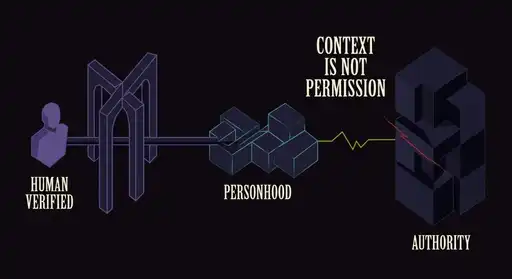
Proof of Personhood Is Not Proof of Authority
September 16, 2026 by Gerardo I. Ornelas
Editorial Series: The Trust Stack: Architecture, Identity & the Battle for Authentic Media — Part II of V
Target Question: Is proving someone is human enough to make an online action trustworthy?
Direct Answer: Proof of personhood can show that an online participant is a unique human, often without revealing who that person is. That is useful for resisting bots, duplicate accounts and some forms of fraud. It does not establish the person’s role, intent, consent or authority for a particular action. Trustworthy systems must keep identity evidence separate from the permissions attached to a consequential act.
The Question AI Makes Harder
The internet has spent decades asking a familiar question: Who are you?
AI adds a harder one: What are you—or the system acting for you—allowed to do right now?
Proof-of-personhood systems promise a way to distinguish unique humans from bots without forcing people to reveal their civil identity everywhere. That is a real and increasingly useful primitive. It can help an application limit one vote, one account or one claim to one human.
But a proof that a human exists is not a blank check for everything that follows.
What Proof of Personhood Actually Proves
World’s whitepapers, updated March 25, 2026, describe private proof of human as infrastructure for an internet populated by advanced AI. Its current developer documentation describes World ID as a self-custodial identity held by the user’s authenticator.
A relying application can request a zero-knowledge proof that the user holds a valid credential. According to the documentation, this can establish verification without revealing the user’s identity. A nullifier can help an application determine whether the same verified person has already performed a defined action.
That is valuable. It can support human-only spaces, rate limits, voting systems and defenses against mass account creation.
It also has a precise boundary: the proof says something about the participant. It does not automatically say whether the proposed action is appropriate.
A unique human may still be mistaken, manipulated, unauthorized or malicious. A legitimate employee may not have permission to release payroll data. A verified voter may not be eligible in a particular jurisdiction. A human may authorize an AI agent to book travel but not to purchase anything above $1,000.
Identity narrows uncertainty. It does not eliminate the need for policy.
The Identity Trap
Authentication becomes dangerous when it turns into ambient authority. An agent may continue acting after the verified person leaves, and a “verified human” badge may be misread as safe or authorized. Good trust UX must state what was verified, in which context and with what limits.
Six Layers That Should Not Be Confused
- Identity asks who or what.
- Personhood asks whether this is a unique human.
- Authentication proves control.
- Authority asks whether the actor may act here.
- Capability defines the action, resource and duration.
- Trust is the resulting judgment.
W3C DID documents model authentication, assertion, capability invocation and delegation separately. The identifier is an input, not the permission.
Privacy Belongs to the Experience
World uses biometric capture and privacy-preserving proofs. Regulators have still scrutinized collection, consent, deletion and minors. Cryptography can reduce disclosure at use time while enrollment, governance and recovery shape total risk. Interfaces should explain what is captured, retained and revocable.
When an AI Agent Acts for a Person
If I ask an agent to sell a camera, identity cannot answer which marketplace it may use, the lowest price, whether it can accept payment, or whether it can act after Friday. Those are authority questions. Interfaces must let people set boundaries before action, inspect them during execution and revoke them.
Original Synthesis: Trust Begins When Identity Stops Pretending to Be Permission
Proof of personhood is necessary in some environments and insufficient in many consequential ones.
The mistake is not verifying humanity. The mistake is allowing a human credential to radiate permission into every connected action.
A better system treats identity as context and authority as a separate, explicit decision. It verifies the right claim at the boundary where consequences occur.
That preserves the benefit of personhood without turning presence into power.
Limits and Counterarguments
A verified human can operate agents or sell access; enrollment can exclude people; granular controls can cause fatigue. Use the lightest proof matching the harm and explicit, revocable authority for consequential actions.
Where This Fits in The Trust Stack
- Part I showed provenance records origin and history but not truth, value or permission.
- Part II adds a second boundary: a human credential still does not grant authority.
- Part III asks whether hardware can anchor capture-time evidence—and where it stops.
Sources & Further Reading
- World Whitepapers (updated Mar. 25, 2026): World Whitepaper
- World ID Docs: World ID Concepts
- W3C DID v1.0: Decentralized Identifiers (DIDs) v1.0
- Regulatory Context (Reuters): Portugal Orders Worldcoin to Halt Data Collection
- The Trust Stack Part I: The Provenance Spectrum: Why a Label Cannot Protect Human Creativity by Itself
- Related Analysis: Verifiably Human — Part II: The Death of Ambient Authority
- Related Analysis: Labor Day in the Age of AI: The Future of Work Is a Human Agency Problem
- Authority Research: The Authority Layer
Frequently Asked Questions
What does proof of personhood prove?
Evidence that a participant is a unique human.
What is the difference between authentication and authorization?
One proves control; the other determines permission.
Can proof of personhood stop AI agents?
It can gate actions to humans, but a human may direct an agent.
© Gerardo I. Ornelas
Systems architect, founder, and advisor for governed AI and trusted visibility.